From Syria to the World
:In the Wake of an Incomplete Revolution, Syrians Participate in a Global Month of Outreach


Across more than a decade of unfinished revolution and civil war in Syria, Syrian activists in exile participated in organizing in other parts of the world. At last, at the end of 2024, the regime of Bashar al-Assad fell, enabling them to begin to return home. One of the projects that Syrian exiles helped to establish is the Peoples Want network, a worldwide network of organizations and collectives seeking to foster an internationalism from below. In the following interview, participants in the Syria group within the Peoples Want discuss the situation they confront in Syria today and describe how they will participate in the Mujawara campaign, a month of events intended to interweave horizontal organizing initiatives around the world.
Can you give us a brief update on the current political situation in Syria? What is the dynamic on the ground for revolutionaries, social movements, and other popular struggles? How do exiled and diasporic communities factor into these?
The fall of the regime enabled millions of people to return to their homes and lands, reuniting families. People are starting to rebuild villages and neighborhoods. Entire towns had been entirely cleansed of their populations.
So the first barrier has fallen—people can safely come home—but the second barrier remains: the economy. The majority of people who left are still in camps or in exile, unable to come back. The government is prioritizing attracting foreign investors and monopolizing resources over rebuilding the large areas destroyed by the Assad regime, most of which were very poor. The horrors of the old regime are still present, too, as people discover mass graves and search for the forcibly disappeared, sometimes finding death certificates without finding the remains. Syrians are still waiting for justice.
We are also living through economic and ecological disasters. Prices are extremely high, wages very low, and the new government has raised the costs for basic necessities such as electricity and food in an unprecedented disproportional way. At the same time, after years of drought, this year saw heavy rains and storms resulting in violent floods that impacted the wheat season and damaged infrastructure in areas including Deir Ezzor and Raqqa, leading to power and water cuts.
During this period, forces within or allied with the new government have committed two massacres, one on the western coast of Syria in March 2025 and one in Sweida in July 2025. The perpetrators enjoy near-total impunity. Serious clashes between the new regime and Kurdish forces in the northeast in January 2026 forced through the integration of large parts of the Syrian Democratic Forces into the new central government in Damascus. In the provinces of Deraa and Qunietra, the Israeli occupation continues to annex lands and strategic positions. In some areas, we are witnessing systematic sectarian pressure on minority groups via through direct violence as well as political and economic abuse of power, including the kidnapping of women and regular clashes between different ethnic or religious groups with or without the complicity of governmental forces.
Nonetheless, despite everything, the fall of the regime has opened some space for collective organizing. Those who were operating underground have started working publicly; groups functioning informally now want to get more organized, and those doing local work want to connect with other initiatives around the country. We have seen groups including an independent journalist union, agricultural cooperatives, civil peace initiatives, and even a housewives’ syndicate. That represents a gain of the revolution. Today, it is possible to organize protests in the street without barrel bombs falling on your head. The government fears demonstrations and has reversed its decisions following protests about the alcohol ban in Damascus, a contested construction plan in Homs, and the price of wheat. Each time, the government has retreated, showing that it fears even small popular mobilization.
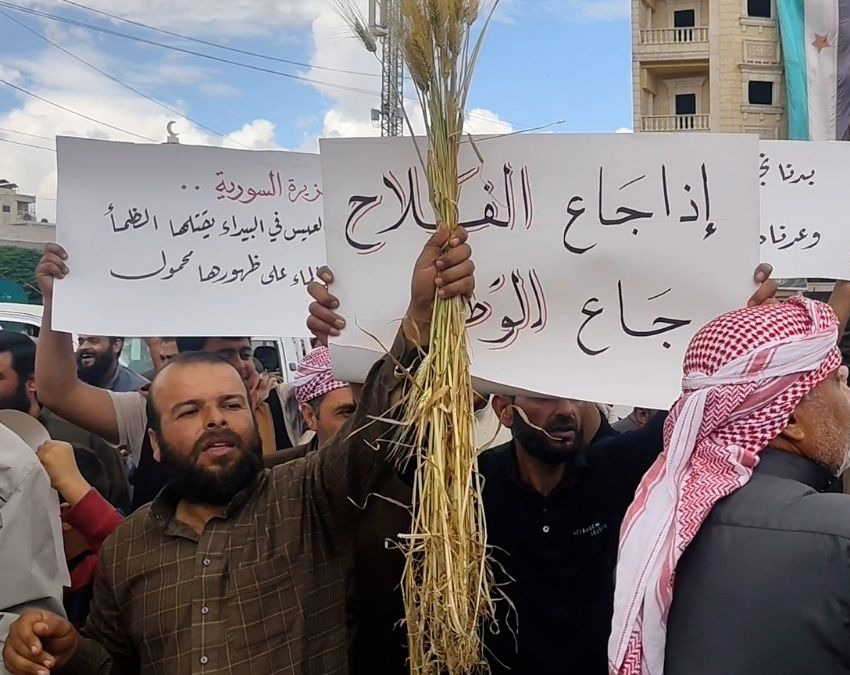
“If the farmer is starved, the country is starved.” A protest against wheat pricing in Raqqa on May 22, 2026.
Still, this will not last if there is no sustained fight to defend the gains of the revolution against a state increasingly veering into authoritarianism. The new government is building its own surveillance and repression apparatus; there are already cases of arbitrary detention, torture in prisons, and pressure to suspend political activities. The question is why it remains difficult to build an opposition capable of confronting its neoliberal, reactionary, and authoritarian tendencies. The political space is there, but the chief obstacle preventing people from organizing against oppression is not the new government per se so much as the country’s divisions along lines of identity.
Identity-based conflicts are extremely strong. Over the past year, opposition movements have often emerged along ethnic and sectarian lines: Druze in the south demanding independence, Kurds in the northeast moving back towards a more Kurdish nationalist project, Alawites demanding separation or autonomy. At the same time, Sunni supremacism among supporters of the government leads to violence and hatred directed at entire communities. Despite the fact that anger at the government’s economic policies is growing across every community including Arab Sunnis, it remains difficult to establish concrete class-based alliances. This is a blessing for the new government: it protects it from any serious opposition, enabling it to present itself as the central balancing force able to restore order.
The situation is further complicates by deep divisions within what used to be the revolutionary camp, especially following the two massacres, because some ex-revolutionaries have tried to justify them or downplay the horror. The chief strategic debate today is over how to position ourselves towards a new government that includes many ex-revolutionaries in public office and the new security forces. Some oppose the new government for reproducing the repressive logic of the old regime; others seek to avoid direct confrontations in a time of local, regional, and global instability.
We believe that we should fight all expressions of authoritarianism and neoliberal policies whenever possible, while distancing ourselves from a reading of the situation that exclusively focuses on the religious ideology of those who run the state.
For those of us who managed to return after the fall of the regime, it is important to learn to understand the context here and listen to those who did not leave the country. The transmission of experience between local activists and those returning from exile will be key, but those who were abroad, especially in Western countries, must not reproduce paternalistic attitudes like “We should teach people how things are done abroad.”
The Syrian revolution received less recognition from revolutionaries in other parts of the world than struggles in Rojava, Palestine, or Chiapas have. What lessons have you derived from this? Why do you think that it is important to focus on expanding international networks of support and solidarity?
There are a number of reasons why we did not see as much solidarity with the Syrian revolution. First, in comparison with the Kurdish movement, the Palestinian movement, or the Zapatistas, the Syrian revolution was a new awakening, which had to begin to establish international connections from scratch. All of those movements had established solidarity over a long period of time through extensive work and relationship building. In the case of the Syrian revolution, much of this work began after 2011, carried out by Syrians in exile and the diaspora, as Syrians who remained inside the country increasingly had to focus on survival.
Another factor in the lack of solidarity for the Syrian revolution is the “campism” that has divided the left in both the West and the Arab world. Campism is the position held by those who see everything through an “anti-imperialist” lens according to which the United States, other Western states, and Israel are the only imperialist actors, or at least, the only imperialists that should be opposed. Consequently, campists invariably defend these nations’ geopolitical competitors—such as Russia, Iran, Hezbollah, and the Assad regime (the “axis of resistance”). They ignored or justified the oppression of Syrians, refusing to support the Syrian revolution and backing counterrevolutionary forces instead.
Still another factor is the lack of a clear discourse and narrative with which to address liberation struggles and leftist groups outside of Syria. The revolutionary movement in Syria was very decentralized. Much of it lacked strong ideological underpinnings, even if various shades of Islamist currents were increasingly present. One lesson is that we can’t count on support from the “international community” that uses the language of “human rights.” We needed to develop a positive project and articulate the kind of change we wanted to make, beyond bringing about the fall of Assad.
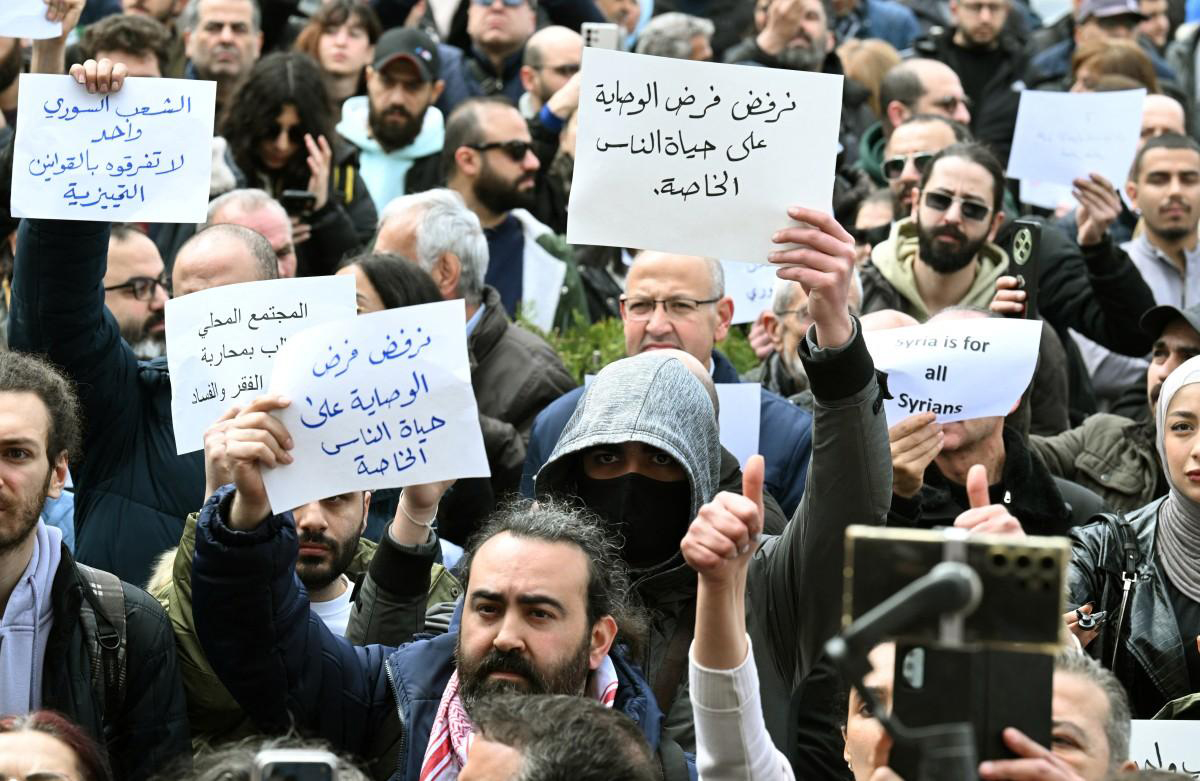
Syrians participate in a sit-in in the Bab Tuma neighborhood of Damascus, on March 22, 2026. “The Syrian people are one; do not divide them with discriminatory laws.”
It is often easier to build solidarity and networks based on trust and mutual support in times of relative “peace” in order to strengthen our alliances for the future. This is a time for Syrians inside and outside Syria to connect and deepen our relationships, as we have much to learn from each other, and also to build relationships with others from around the world. We believe that by working together, increasing our knowledge of transnational struggles, sharing our resources, and recognizing each other as actors in a common struggle for liberation, we can strengthen and sustain our movements at home.
What can you tell us about the Mujawara campaign of The Peoples Want and how it relates to self-organized initiatives underway in Syria?
The “Mujawara” campaign is not a general slogan about solidarity, but a concrete attempt to build connections between spaces and initiatives that already exist on the ground both within Syria and outside it. The idea is to look for places where something of the spirit of self-organization has survived—houses, farms, social centers, local councils, agricultural initiatives, feminist and youth groups—and to see how we can support them, learn from them, and connect them with other experiences.
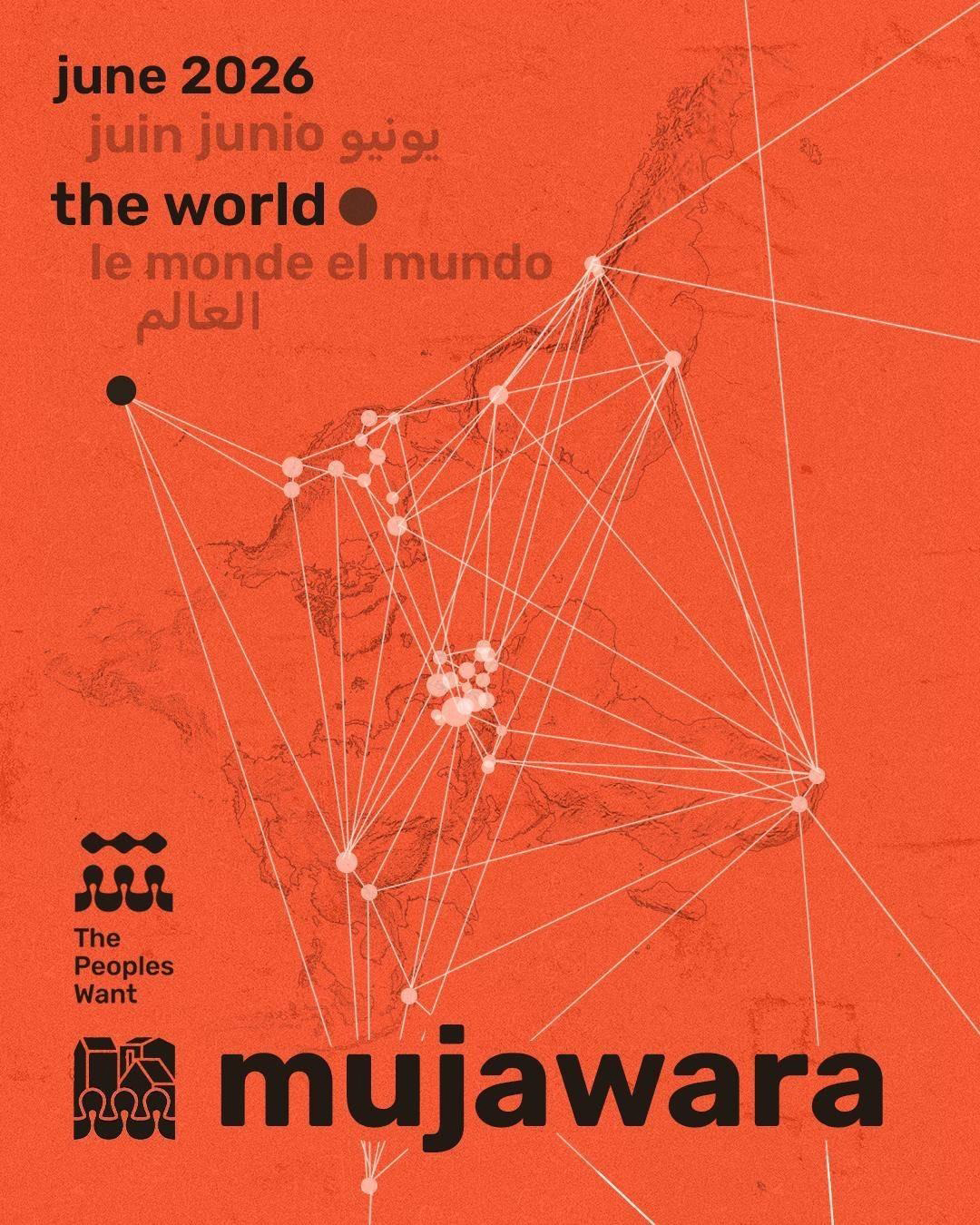
In Syria, we started working in a very concrete way: visiting, meeting, discussing, and assessing the spaces we could collaborate with. For example, in a particular city, there is a space run by a local team whose members did not leave the country, with a building and a garden and the capacity to receive people and organize meetings. This space is very close to the idea of “Mujawara”: an independent place rooted in the local environment, based on relations of trust, open to social, political, and cultural activities, and capable of hosting meetings for comrades from different areas. That is why we will organize a gathering there during the month of June as part of the Mujawara campaign. Through this gathering, we will get to know more about the people running the space, and we will invite other groups and places we have visited in Syria to join us. We will cook together, listen to each other’s experiences and struggles, and talk about the role that the Peoples Want network can play in the Syrian context.
We have also visited and discussed with other places and collectives. In one city, there is a new initiative started by some old revolutionaries returning from exile: an Arab house that hosts political, social, and cultural activities for adults and children. In June, in this space, we will organize a film screening and discussion about the Sudanese revolution, in the presence of local activists and a Sudanese comrade who is a member of a resistance committee in Khartoum. The opportunity to do this—not only in exile but in Syria—represents the fulfillment of a dream: connecting people involved in the two revolutionary experiences that inspired our manifesto “Revolutions of Our Times” and which serve as something like a political compass for the network.
We have visited a place in one of the suburbs of Damascus, a lovely social center with a café and large spaces around it. Political events were taking place there underground before the fall of the regime. In the countryside around Damascus, we have also visited agricultural projects, nurseries, and seed collections connected to question of food sovereignty and the rebuilding of the land after destruction. In the northwest, we have connections with other agricultural and women’s initiatives focused around medicinal plants and local knowledge. Ecological farming initiatives give us a clear example of how politics can begin not only from statements but from the seeds, from the water, from the land.
In all these places, we have discussed internal organization and political visions for the future. We did not treat these initiatives with romanticism. Every place and project has its contradictions, its problems, its social and political questions and limits. That is why we do not see “Mujawara” as a stamp of approval that we place on any space, but rather a process of building trust and joint work.
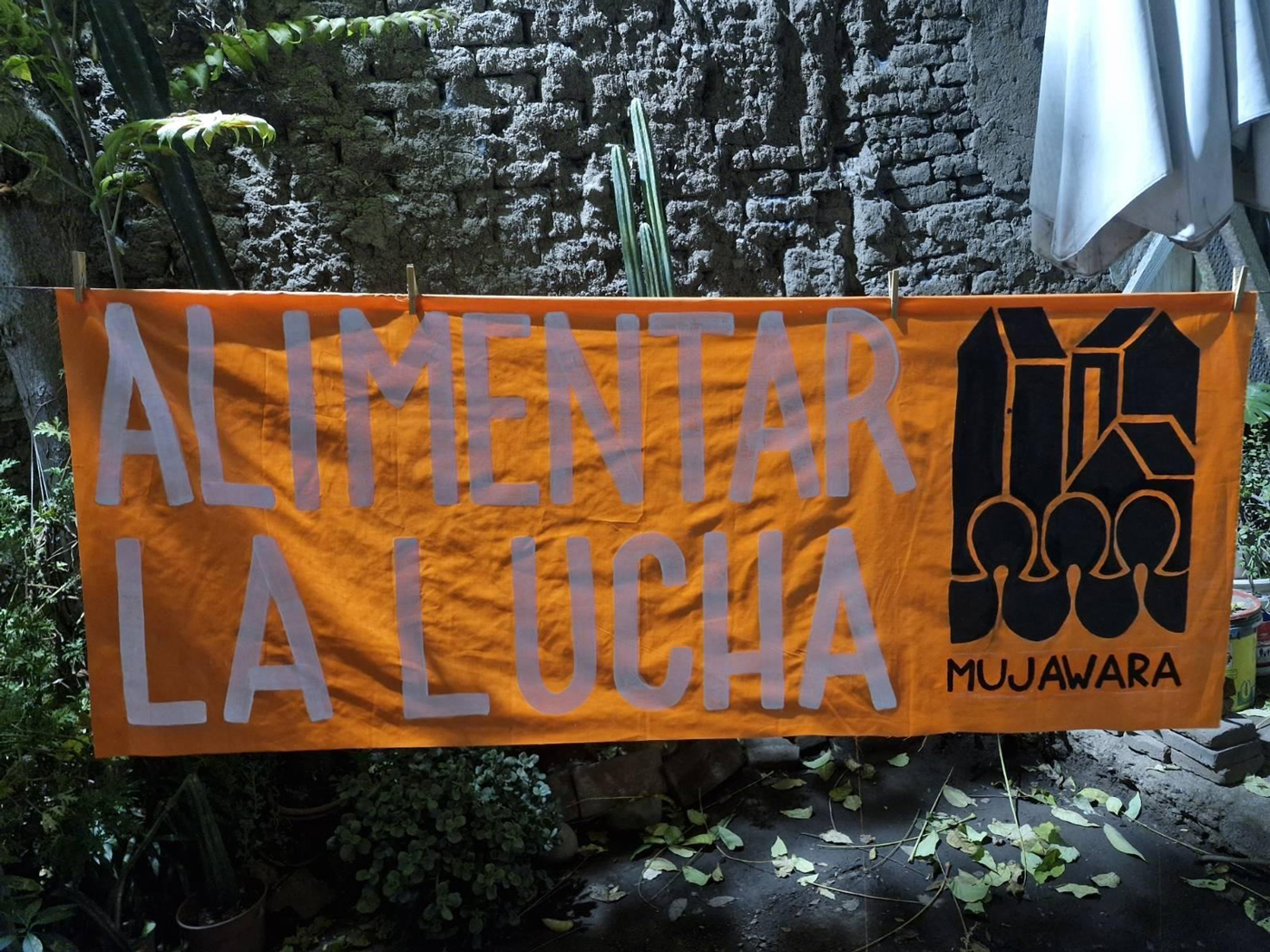
A banner for the Mujawara campaign elsewhere on the surface of the earth, displayed by other participants in the Peoples Want network.
What matters to us is connecting with and supporting self-organized initiatives, not replacing them or leading them. As Syrians, we know that people on the ground are tired of organizations that come with ready-made projects and of funding that creates a donor-recipient relationship. First, we ask: What do you need? How do you work? What is your relationship with the local environment? Can this space receive people from different areas? Does it contribute to building material and political autonomy for people?
The connection of “Mujawara” with Syria comes from this: the Syrian revolution itself gave rise to a tremendous amount of experience in self-organization, from local councils to coordination committees, from collective kitchens to field hospitals, from justice initiatives for victims and the disappeared to farming projects and cooperatives. Today, after the fall of the regime, after all of this destruction, it is not enough to say “the revolution continues” as a slogan. The question is: where does it continue? And who carries it in a concrete way? In which house, farm, library, social center, community committee, or meeting between people from different places in Syria will it continue?
That is why in Syria, “Mujawara” must be a small but practical step: meetings for collective thinking about how to build a long-lasting mutual support network. The goal is not to announce the “opening of a revolutionary headquarters,” but to contribute to restoring the connections between people, areas, and experiences that years of war and revolution has separated.
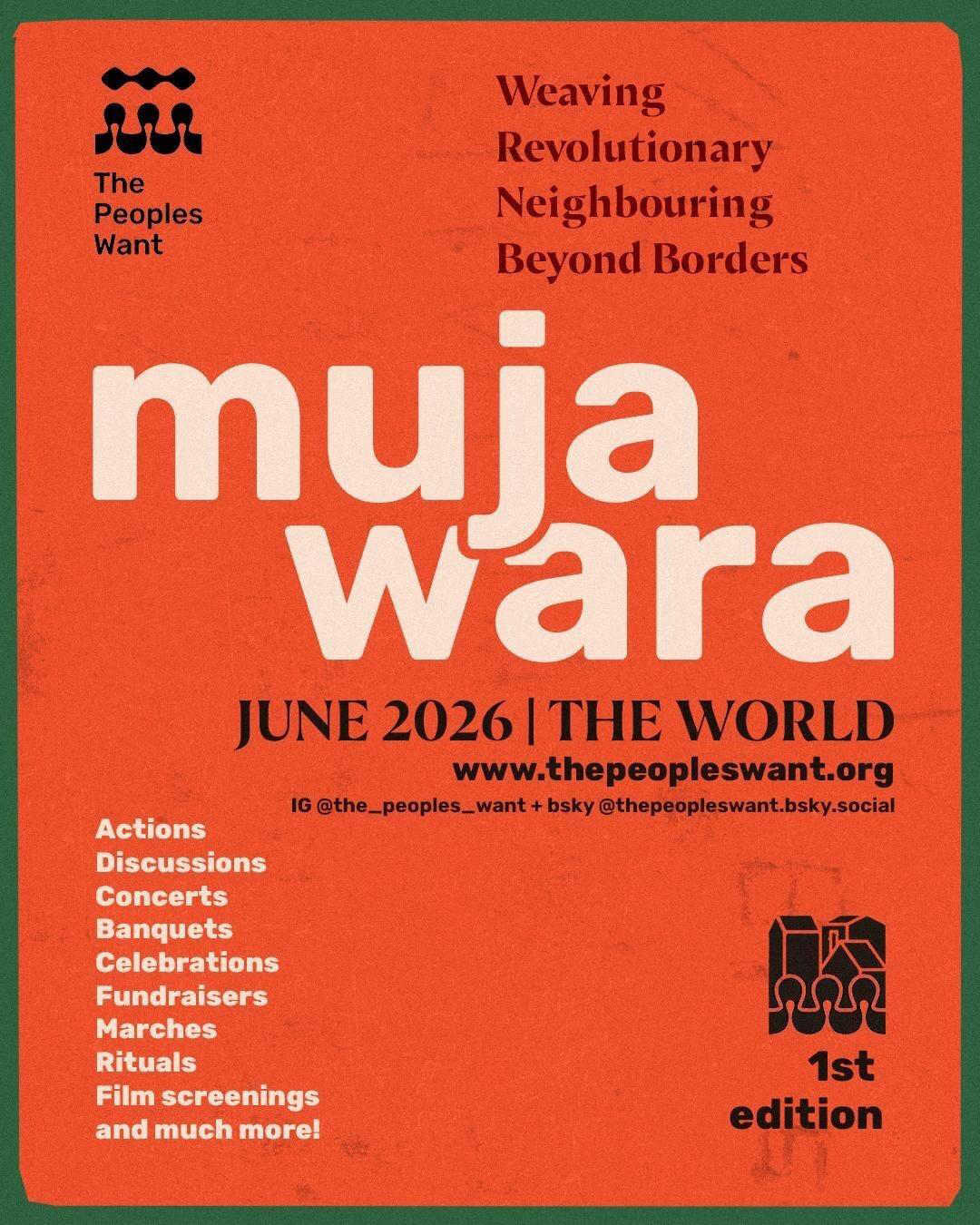
Appendix: The Mujawara Call
This is the original call to make June a month of global outreach and connection through the Mujawara campaign.
Join us for a month of internationalist organising throughout the month of June! This is a global call to all local places and collectives for gatherings, actions, communal banquets, celebrations, fundraisers, marches and rituals in honor of those who have fallen.
The goal is to build new internationalist connections and mutualize our resources to support the creation of new shared spaces by Syrian and Sudanese revolutionaries.
Mujawara: Weaving a Revolutionary Neighboring Beyond Borders
We could begin again with a list. A list of threats, of wars, of uprisings cut short, of incomplete revolutions. A list of all the dead, of all our dead.
But why state again what everyone knows, reads, sees, and feels: The world, once again, is devastated by the lust for power and the greed of the powerful.
So how do we carry on? We who have known the jubilant crowds, the ransacked palaces, and the power of our tenderness. How do we carry on in the face of horror and powerlessness? How do we carry on as revolutionaries?
There are the cynics, the “realists,” who, blinded by the anguish of their own weakness, tell us we must choose. Choose between those who massacre their own peoples and those who believe they can slow their own downfall by declaring war on the world.
There are those who give up or stop hoping. Exhausted, resigned. But who may one day stand with us again.
And then there is us.
Us who weep, us who feel weak, us who sometimes doubt. But us, too, who have not given up. Neither our compass, nor our flame. Neither the hope of avenging our own, nor the hope of seeing a dawn at the end of the night.
Us who, rather than remain trapped in the shock of the present, search everywhere for those who continue to resist. For we remember that from our uprisings, a force has awakened. And though minds tend to forget, bodies remember.
Us who see this force still alive in plain sight, carried by a pirate generation shouting in the world’s face that the game is not over.
It is this force that our comrades in Nepal have rekindled in the open, in flames that consumed their assembly. It is this force that we have glimpsed within the plenums of Serbia, those gigantic assemblies that, for months upon months, organised the revolt from below. It is this force too that is embodied in the inhabitants of Lebanese villages who remain on their land despite yet another evacuation order from the IDF, as well as in the farmers in Palestine who replant their crops again and again after the bombs. It is this force that we feel within the Sudanese emergency response rooms, born of war to take up the mantle, both at home and in exile, of the powerful resistance committees of the revolution.
It is this force that keeps our comrades standing firm in the jungles of Myanmar or Chiapas, in the Ukrainian trenches, and in the mountains of Rojhelat. It is this force that we see flying at the mastheads of those boats setting sail to defy genocidal Israel. It is this force, finally, that drives the crowds in Iran, Minneapolis, Peru, Indonesia, the Philippines, Morocco, and Madagascar to brave, time and again, the death promised by all these regimes that hate their peoples.
Yes, our strength is real. It is nascent, incomplete, fragmented, but real. Contrary to what counterrevolutionaries on both the right and the left would have us believe. And no party, no supreme savior, will be able to unify it in our place.
So the task lies with us: to seek one another out, to recognize one another, and to make visible to the world—and to ourselves—the power that could emerge from our coming together.
This is what we call Mujawara. The pooling of our efforts and our resources, through the interweaving of ropes, long and strong enough to allow us to hold together in the face of the challenges of our time. A revolutionary neighboring that we have already begun to weave from all these territories, these places, and popular powers born of our struggles. This Mujawara will not be made of empty talk or grand statements on every tremor our world experiences. It is being built, and will continue to be built, under the radar, in the tunnels of the revolutions to come.
And to inaugurate it, and to begin weaving this neighboring that crosses borders, we will organize, across five continents and throughout the month of June, a series of internationalist actions within all these places born before or in the wake of our uprisings and maintained over the years despite every hardship: neighboring councils, autonomous spaces, social centers, shelters, collective farms, self-managed bookshops, cooperatives.
All that will allow us to bring into being, materially and symbolically, this neighboring we need: gatherings, actions, communal banquets, celebrations, fundraisers, marches, rituals in honour of those who have fallen.
From this global mutual aid that we will set in motion in June, new places will rise from the ground, safer paths will be forged, roofs will be repaired, new alliances will be woven, and from all of this, perhaps, wounds will be healed and new hopes will take root.
This moment is but a step—yet a decisive one: that of the slow but unwavering construction of a grounded material power, linking across the four corners of the planet the fragments of our nascent strength.
From the places we have grown accustomed to naming:
Taipei, Mexico City, Nancy, the Beqaa Valley, Berlin, Santiago de Chile, Galloway hills, Paris/Montreuil, Damascus, la Provence, the Limousin mountain